Achieve Enhanced Support with Internal Mesh Breast Lift
Dr. Amir Ghaznavi is a double board-certified plastic surgeon (American Board of Plastic Surgery and American Board of Surgery) with over 200 internal bra cases and over 750 career breast revisions. He completed his microsurgery fellowship at Cleveland Clinic, has published peer-reviewed research in Plastic and Reconstructive Surgery (2018) and JPRAS (2017), and serves on the ASPS Cosmetic Subcommittee.
At AMG Plastic Surgery in Herndon, Virginia, internal bra surgery is performed as part of breast lift, breast revision, and breast augmentation cases requiring durable structural support. Dr. Ghaznavi selects between two FDA-cleared resorbable meshes, Durasorb and GalaFLEX, based on each patient’s tissue quality, degree of ptosis, and goals. Patients from Northern Virginia, Loudoun County, Fairfax, Ashburn, Reston, and the greater DMV travel to AMG for this technique.
What Is Internal Bra Surgery
Internal bra surgery places a thin, resorbable mesh beneath the breast tissue to provide long-lasting structural support. The mesh acts as a scaffold while the body’s own collagen builds around it. The mesh dissolves over a period of months and is replaced by stronger native tissue.
The internal bra is an adjunct technique. It is added to:
- Breast lift (mastopexy)
- Breast reduction
- Breast augmentation
- Breast revision
The mesh provides durability skin and ligaments alone cannot, particularly in patients with stretched tissue from pregnancy, weight loss, prior surgery, or aging.
Two FDA-cleared resorbable meshes are used at AMG: Durasorb (polydioxanone) and GalaFLEX (poly-4-hydroxybutyrate). The difference between them is how long each stays before dissolving, which determines which mesh is right for which patient.
The Mesh: Durasorb or GalaFLEX
The mesh selection is matched to your tissue and your case. Neither mesh is universally better.
Durasorb (polydioxanone, PDO)
- Same polymer family as PDS suture, used safely in plastic surgery for over 40 years
- Resorbs in 6 to 12 months
- Load transfers to your own collagen within the first 3 months
- Right for most internal bra cases
- FDA-cleared 2018 for soft tissue reinforcement
GalaFLEX (poly-4-hydroxybutyrate, P4HB)
- Resorbs over 18 to 24 months
- Right for patients needing extended structural support
- Indicated in: significant ptosis after massive weight loss, poor skin elasticity, revision mastopexy with weakened tissue, augmentation revisions with thin tissue coverage
- FDA-cleared 2014 for soft tissue reinforcement
- Available in a stiffer 3D scaffold (GalaFORM) when added rigidity is required
Both meshes integrate into native tissue through the same biological process, stimulating type I collagen deposition. Both are pliable. Costs are comparable. No head-to-head clinical study has shown a clear outcome advantage of one over the other when properly indicated.
All resorbable mesh use as soft tissue support in elective breast surgery is technically off-label. Both meshes are FDA-cleared for soft tissue reinforcement generally. Their use for breast support is established standard of care in aesthetic plastic surgery.
Dr. Ghaznavi makes the mesh selection at consultation after evaluating your tissue quality, degree of ptosis, prior surgical history, and long-term goals.
Internal Bra vs. Traditional Breast Lift
A traditional breast lift in Northern Virginia removes excess skin, repositions the nipple, and relies on the skin envelope to hold the new shape. For patients with good skin elasticity and moderate ptosis, this is often sufficient.
Skin stretches over time. Pregnancy, weight fluctuation, aging, and gravity work against the lifted position. In patients with poor skin quality, significant ptosis, or prior surgical history, the traditional lift loses shape within a few years.
Adding resorbable mesh creates an internal support structure not dependent on skin alone. By the time the mesh dissolves, the body has built its own reinforced collagen framework to hold the lifted shape.
The trade-off is cost and operating time. Internal bra mastopexy costs more than standard mastopexy because of the mesh material and the additional surgical time required. For patients who have already had a lift fail or who have anatomy predicting high risk of recurrent ptosis, the added cost is justified by durability.
Dr. Ghaznavi performs both standard lifts and internal-bra-supported lifts. The decision is made together based on tissue evaluation and realistic long-term expectations.
Internal Bra With or Without Implants
The internal bra technique works with breast implants and without breast implants.
With implants
Combined with breast augmentation, the mesh provides lower-pole support, helps maintain implant position, and prevents bottoming out. It also reduces visible rippling in thin-coverage patients and decreases capsular contracture risk in some clinical scenarios. Particularly useful in revision augmentation where prior surgery has weakened the tissue envelope.
Without implants
The internal bra functions as a stand-alone support structure for patients who want a natural-tissue lift without an implant. The mesh provides the lift and shape an implant would otherwise contribute, working with your own breast tissue rather than augmenting volume. Right for patients with adequate breast volume needing durable lift, including post-weight-loss patients whose breasts have lost shape but retain enough tissue to reshape.
The decision is driven by tissue volume, body proportions, and aesthetic goals. Dr. Ghaznavi gives a clear recommendation at consultation based on your anatomy.
I had an arm lift and a breast lift after weight loss, and I’m very pleased with the results. I’ve felt completely supported and well cared for this entire journey, and would absolutely recommend this practice to anyone seeking a good plastic surgeon.
Why Patients Choose Dr. Ghaznavi for Internal Bra Surgery
Volume
Over 200 internal bra cases. Over 750 career breast revisions. Among the highest-volume internal bra surgeons in Northern Virginia.
Training
Microsurgery fellowship at Cleveland Clinic. The technical precision required to operate on sub-millimeter blood vessels translates directly to internal bra mesh placement.
Credentials
Double board-certified by the American Board of Plastic Surgery and the American Board of Surgery. Fellow of the American College of Surgeons.
Research
Peer-reviewed publications in Plastic and Reconstructive Surgery (2018) and JPRAS (2017). Member of the ASPS Cosmetic Subcommittee, contributing to the national standards governing cosmetic breast surgery.
Prior experience
Director of Plastic Surgery at Ahuja Medical Center and staff surgeon at Cleveland Clinic Florida, with high-volume breast reconstruction case experience that built the foundation for the current mesh-supported aesthetic technique.
Long-term tracking
Dr. Ghaznavi tracks outcomes on his internal bra patients. The result is a practice refined around which mesh works for which patient, where it should sit, and how to combine the technique with capsulorrhaphy, vertical scar mastopexy, Wise pattern lift, and autologous augmentation.
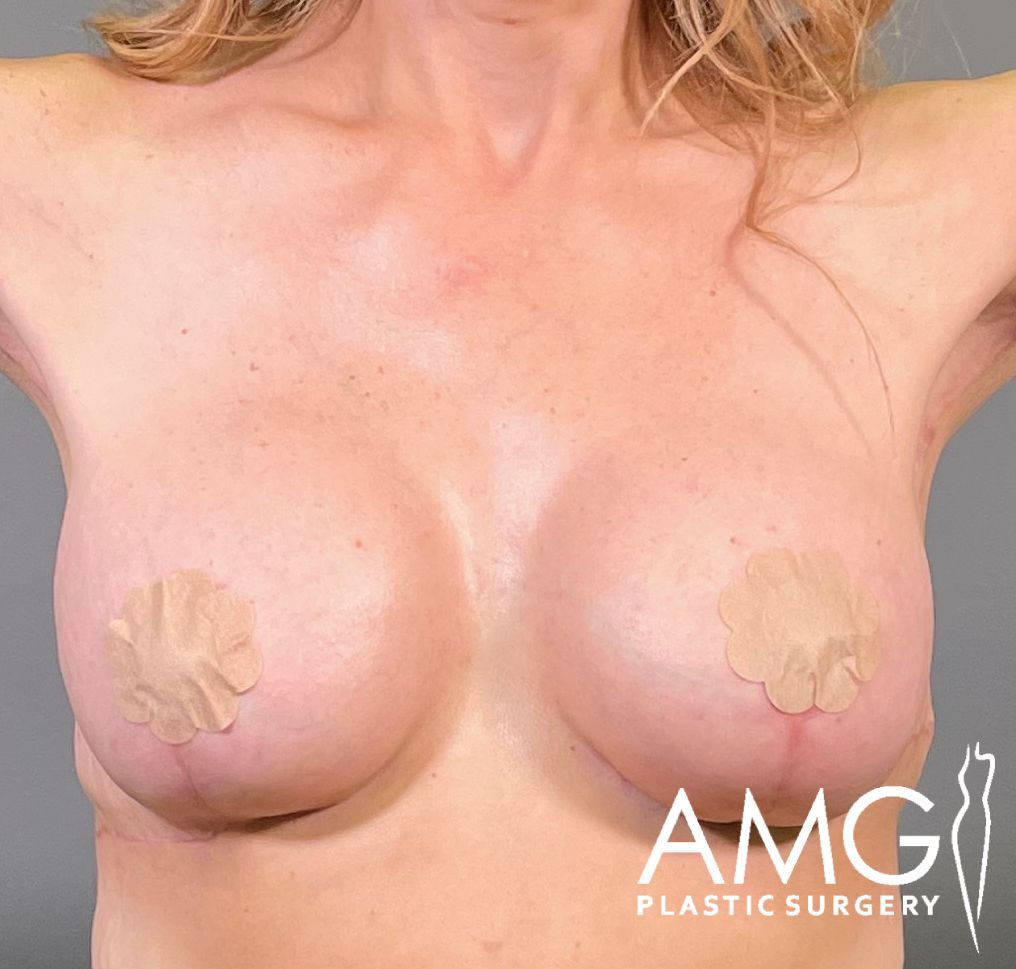
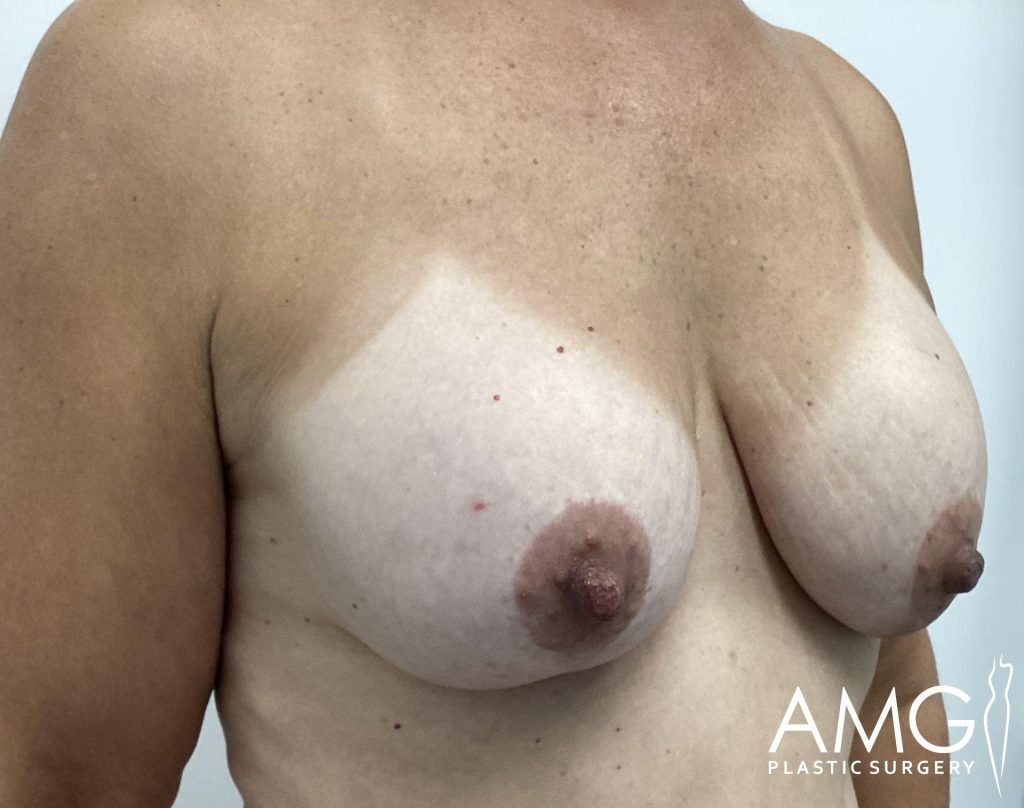
Before and After
Case 1

Case 2

Recovery After Internal Bra Surgery
Internal bra surgery is performed under general anesthesia. Operative time is typically 2 to 4 hours depending on the procedure it is paired with. Most patients return home the same day.
Week 1
Bruising, swelling, and tightness. Surgical bra worn continuously. Prescription pain medication for the first few days, transitioning to over-the-counter pain control. Desk work or light remote work at 7 to 10 days.
Weeks 2 to 4
Bruising fades. Light daily activities resume. Driving returns once pain medication is discontinued.
Weeks 4 to 6
Routine activity restrictions lift. Light cardio resumes. Upper-body strength and chest exercises remain restricted.
Weeks 6+
Full return to exercise typically cleared at six weeks. Final shape continues to refine over the following 3 to 6 months as the mesh integrates and swelling fully resolves.
Follow-up visits with Dr. Ghaznavi at 1 week, 1 month, 3 months, and 1 year.
Cost and Financing
Internal bra surgery cost varies based on the procedure pairing, mesh selection, extent of lift, and operating time required. Specific pricing is provided at consultation after Dr. Ghaznavi evaluates your case and a personalized surgical plan is built.
AMG Plastic Surgery is a premium out-of-network practice. We do not accept insurance for cosmetic procedures.
Financing partners:
We work with Cherry, CareCredit, Alphaeon Credit, and Northwest Federal Credit Union. Approval, rates, and repayment terms depend on the applicant and the lender. Apply directly with the lender to see your options.
Payment options through Cherry Technologies, Inc. are issued by its financing partners: withcherry.com/financing-partners
A consultation fee applies and is credited toward the cost of your procedure. Current fee details are listed on our patient information page.
Frequently Asked Questions About Internal Bra Surgery
The mesh dissolves within 6 to 24 months depending on which material is used. The lift result is intended to last for many years. The body builds its own collagen framework around the mesh, leaving behind a stronger native support structure. Aging, weight changes, and pregnancy still affect the breast over time.
No. Durasorb and GalaFLEX are thin, flexible, and positioned beneath the breast tissue. Not visible externally. Most patients do not feel the mesh during the months it is present. The mesh does not interfere with mammograms or breast ultrasound.
The mesh itself is not permanent and fully dissolves. The body’s own reinforced collagen structure remains and is what delivers the long-term result. The lifted shape is intended to be durable over many years.
As with any surgical procedure, risks include infection, bleeding, scarring, changes in nipple sensation, asymmetry, and the need for revision. Mesh-specific considerations include seroma, delayed wound healing in poor-tissue patients, and rare mesh exposure. Dr. Ghaznavi discusses your specific risk profile at consultation.
Yes. Most commonly combined with breast augmentation, breast reduction, breast lift, or breast revision. Many patients also combine breast procedures with body contouring, particularly after weight loss. Combined cases are evaluated individually for safety based on operating time and anesthesia load.
Immediate shape change is visible after surgery, though early swelling makes the early result misleading. The breast settles over 3 to 6 months. Final result is evaluated at the 6-month and 1-year follow-up visits.
No. Cosmetic internal bra surgery is self-pay. Financing is available through Cherry, CareCredit, Alphaeon Credit, and Northwest Federal Credit Union.
Dr. Ghaznavi selects between Durasorb and GalaFLEX at consultation based on your tissue quality, degree of ptosis, prior surgical history, body type, and long-term goals. For most patients, Durasorb provides the right duration of support. Patients with significant ptosis, poor skin quality, post-weight-loss anatomy, or revision cases more often benefit from GalaFLEX.
Schedule Your Consultation
Internal bra surgery is a meaningful decision and deserves a thorough evaluation. Dr. Ghaznavi reviews your anatomy, prior surgical history, goals, and candidacy at consultation. He recommends whether the internal bra is the right technique for you, which mesh is appropriate, and whether implants should be part of the plan. AMG Plastic Surgery is located in Herndon, Virginia, serving Northern Virginia, Fairfax, Ashburn, Reston, Loudoun County, and the greater DMV area. Call (703) 239-3190 or use the form below.
Medically reviewed by Amir Mahan Ghaznavi, MD, MBA, FACS on